Medical product packaging requirements need to connect product protection, labeling, traceability, applicable rules, and the actual distribution route. Buyers should identify which package level performs each function, agree who owns technical and regulatory decisions, and evaluate the same controlled revision across quotations, samples, production, and shipment.
Key takeaways
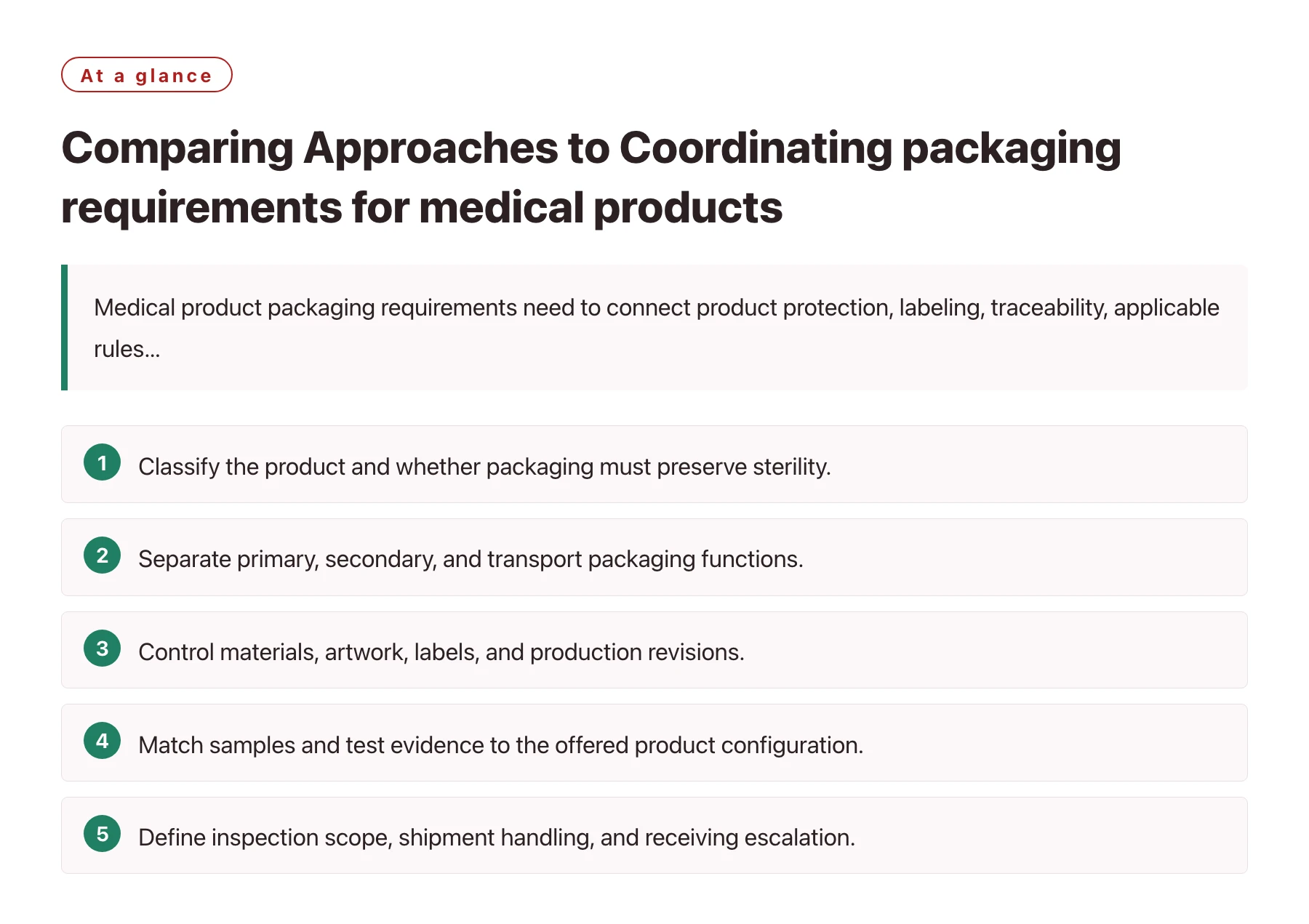
- Classify the product and whether packaging must preserve sterility.
- Separate primary, secondary, and transport packaging functions.
- Control materials, artwork, labels, and production revisions.
- Match samples and test evidence to the offered product configuration.
- Define inspection scope, shipment handling, and receiving escalation.
Packaging gaps often appear late because the product, label, sterile barrier, carton, and freight plan are specified by different teams. A short controlled requirement set helps buyers expose those dependencies before production.
Classify the product and packaging purpose
Begin with the device’s intended use, configuration, sales unit, and shipping route. A reusable instrument, a non-sterile disposable, a sterile single-use device, and an accessory may need different packaging controls. State whether the pack protects the product from impact, dust, moisture, tampering, contamination, or loss of small components, and identify which package level performs each function.
For products supplied sterile, distinguish the sterile barrier from protective packaging and the outer shipping carton. Identify the validated configuration, sterilization method, shelf-life claims, and who controls sealing and release. The FDA’s recognition entry for ISO 11607-1 describes packaging requirements for terminally sterilized devices and refers to ISO 11607-2 for validation of forming, sealing, and assembly processes. Buyers should confirm applicability with the manufacturer and regulatory owner; a packaging checklist does not validate a sterile barrier.[1]
List product variants and worst-case configurations that affect packaging: sharp edges, fragile tips, heavy components, fluid paths, batteries, accessories, or multiple pieces in one kit. A pack that works for one model may not protect a longer, heavier, or more delicate variant. Link each device code to its packaging drawing and revision.
Define package levels and protection needs
Specify the primary package in contact with or immediately surrounding the product, the secondary carton or tray, and the transport package. State materials, dimensions, closure method, cushioning, dividers, seals, and any desiccant or barrier layer required. Use material descriptions that can be verified, and identify approved equivalents and prohibited substitutions.
Describe the hazards expected during handling and distribution. Consider compression, vibration, drops, abrasion, humidity, temperature exposure, puncture, and stacked storage, based on the actual route and product sensitivity. Assign test conditions and acceptance criteria to a qualified packaging or engineering owner. Do not describe a package as transport tested unless the test configuration, method, and result can be traced to the offered design.
Where the package is intended to preserve sterility, treat seal width, seal integrity, material compatibility, opening method, and traceability as controlled requirements. Avoid changing film, paper, adhesive, tray geometry, or sealing parameters through an informal supplier substitution. The manufacturer should establish which changes require evaluation, revalidation, or regulatory review.
Make labeling and traceability explicit
Create a label data table for every sales unit and shipper case. Specify product name, model or catalog number, lot or serial identifier, quantity, symbols, language, manufacturer details, expiry or manufacture date when applicable, and barcode format. The regulatory owner should approve required statements and symbols for each destination market; artwork supplied by a buyer should not be assumed compliant without review.
Define print quality and location: label dimensions, placement zones, contrast, durability, and whether text must remain legible after handling. Identify which data are fixed and which change by lot. For variable data, state the approved source system, verification step, and records retained for each production run.
Tie the device, primary package, carton, and shipment records together using consistent identifiers. Ask the factory to demonstrate a label reconciliation process so obsolete artwork or mixed lots do not enter the same shipment unnoticed. Approve proof files and retain dated versions before mass production.
Control samples, testing, and production changes
Request a packaging sample made with the specified materials and production process. Inspect fit, closures, abrasion points, product movement, label placement, opening experience, and whether all accessories remain separated and identifiable. Document the sample code, device revision, packaging revision, and any deviations. Keep reference samples when they help receiving teams compare a later lot.
Ask for evidence that corresponds to the actual model and package configuration. Reports should identify the test method, sample construction, date, results, and responsible laboratory or reviewer. If the manufacturer relies on existing validation, ask how the supplied configuration maps to the evaluated design. A certificate for a material alone does not demonstrate that a finished package protects the device through the intended route.
Use a written change-control process for material, supplier, dimensions, artwork, sealing equipment, process settings, or carton configuration. Require impact review before implementation. Decide who can approve a change and whether a new sample, transport evaluation, seal check, or regulatory assessment is required. Record the approved effective lot so production and receiving can identify the governing revision.
Plan inspection, shipment, and receiving checks
Define what an incoming or pre-shipment review can realistically observe: package identity, count, visible damage, label content, seal appearance, carton marks, and required records. Set sampling and acceptance rules with the quality owner. Visual examination cannot establish sterility, hidden package integrity, or regulatory conformity unless a suitable method and qualified reviewer are specified.
Give the supplier a packing instruction that covers inner pack count, orientation, separators, pallet pattern, stretch wrap, moisture protection, carton limits, handling marks, and mixed-lot rules. Include gross and net weights and external dimensions needed for freight planning. Make sure cartons remain identifiable after consolidation and that shipping marks do not obscure regulated labeling.
At receiving, record shipment condition, lot identifiers, count, and any crushed, wet, opened, or punctured cartons. Define segregation and escalation steps for suspect packages. Preserve photographs and packaging records with the purchase order so the quality team can determine whether a concern is limited to outer transit packaging or may affect the device or sterile barrier.
Turn the requirements into a supplier comparison
Send one controlled packaging specification and artwork revision to each supplier. Ask them to respond line by line with proposed materials, package dimensions, included tests, exclusions, lead time, tooling charges, minimum order quantities, and unresolved questions. Compare each response against the same criteria rather than allowing a low price to hide a different package level or unvalidated substitute.
Separate the supplier’s manufacturing responsibilities from the buyer’s decisions. Identify who owns regulatory content, artwork approval, packaging validation, change review, inspection, and final release. For medical supplies sourcing, buyers can consider sourcing support as a way to coordinate supplier questions and samples; define the scope and leave technical acceptance with the designated qualified owner.
Before purchase release, confirm the approved device and package revisions, production sample, label proof, testing evidence, shipment pack plan, and escalation route. Keep decisions in a controlled record rather than relying on chat messages that may not follow the order through production.
Sources
Frequently asked questions
Can a package material certificate prove a finished medical device package is suitable?
No. It covers a material or stated property. The finished configuration, process, product, route, and applicable requirements need their own documented evaluation.
Who should approve medical device label content?
The designated regulatory or quality owner for the destination markets should approve required statements, symbols, languages, and variable data before production.
Can packaging be changed after a sample is approved?
Treat a change as a formal revision. Assess its effect on fit, protection, labeling, sealing, validation, and regulatory obligations before implementation.
What can a visual pre-shipment check confirm?
It can document visible identity, count, label placement, carton condition, and specified records. It cannot establish hidden package integrity or sterility without suitable methods and qualified review.