Two Settlement Schemes, One 118 TH/s Machine
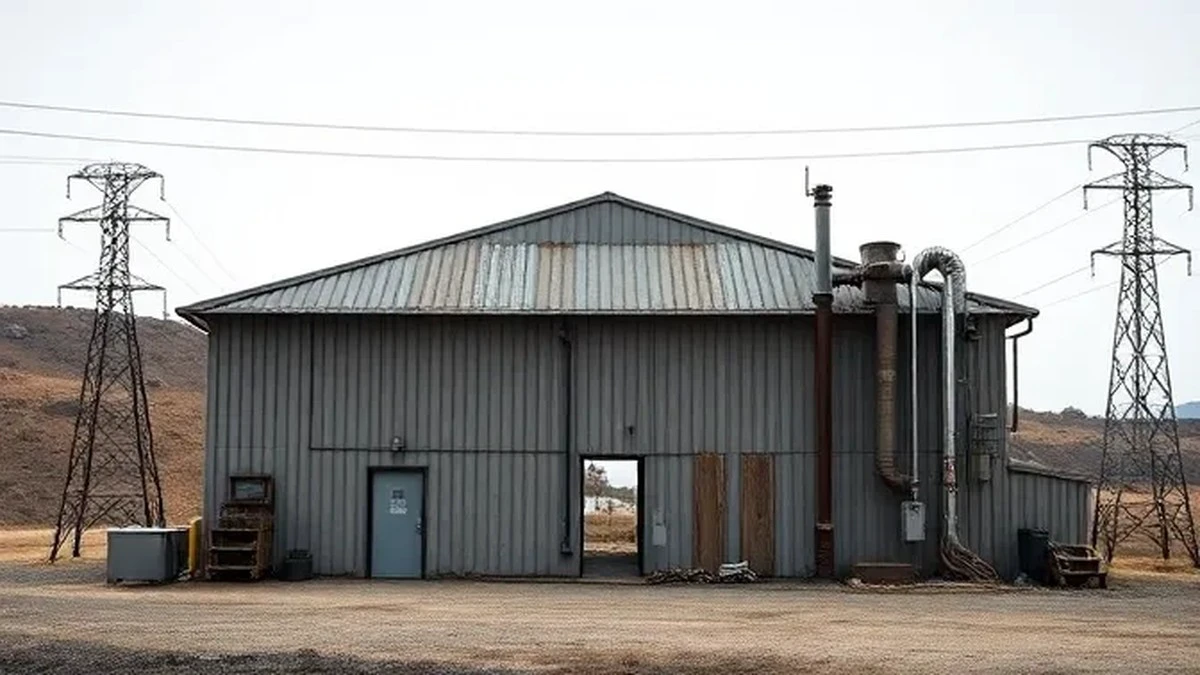
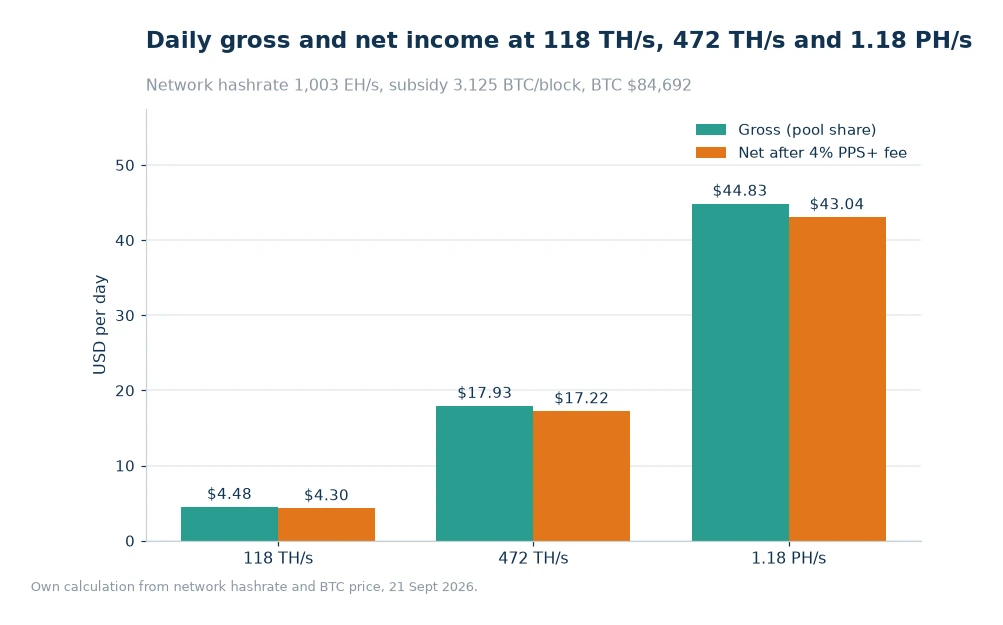
The same 118 TH/s machine settles 5.294e-05 BTC a day, worth $4.48 gross at $84,692. Under PPS+ the block-reward part is paid hourly against difficulty with a listed 4% taken, leaving $4.30. Under PPLNS the block reward and transaction fees share a single 2% rate after six confirmations, so the percentage is smaller and the timing is not.
Key takeaways
- 118 TH/s produces $4.48 a day gross; PPS+ leaves $4.30 after the listed 4% on the block reward.
- PPLNS applies a listed 2% to the combined block reward and fees, but only after six confirmations.
- The PPLNS window covers the last five difficulty rounds, so leaving and rejoining dilutes a miner's slice.
- Neither scheme changes expected value before fees; they change who carries the variance.
Hourly certainty against a rolling window
PPS+ pays for shares. The block-reward portion is credited every hour at the current difficulty, so the miner receives the expected value of their contributed work whether or not the pool has a good day. That is why a miner on PPS+ can open the account on a Tuesday morning and find a credit that matches yesterday's rate almost to the satoshi.
A credit that matches the previous day is not a guarantee, but it is a usable planning input.
PPLNS pays for blocks. It waits until a block the pool found has six confirmations, then divides that block among miners according to their share of the pool's hashrate across the previous five difficulty rounds. A miner who has been hashing continuously gets the full weighting; one who stopped for a day has a thinner presence in the window and a smaller slice.
The practical difference is who absorbs the pool's luck. Under PPS+ the pool does, which is why the listed rate on the block-reward component is higher. Under PPLNS the miner does, in exchange for a lower listed rate on both components combined.
Where the 4% and the 2% sit
The two percentages are not alternative prices for the same thing, and treating them as such produces a wrong comparison. PPS+ charges 4% against the block-reward slice and 2% against the transaction-fee slice. PPLNS charges 2% against the two combined. If a block's value were entirely subsidy, PPS+ would cost 4% and PPLNS 2%; as the fee share grows, the blended PPS+ rate falls toward 2%, because the fee slice is charged at the lower rate.
A worked blend makes this concrete. If one tenth of gross revenue came from transaction fees and nine tenths from the subsidy, the PPS+ blended rate would be 0.9 × 4% + 0.1 × 2%, which is 3.8%. At a fee share of one fifth it would be 3.6%. The rate is not fixed because the mix is not fixed, and a miner comparing schemes during a quiet mempool is comparing the case where the two are furthest apart.
The five-round window in practice
Five difficulty rounds is roughly ten weeks of pool history. That length is deliberate: it smooths out the effect of a single lucky or unlucky block, and it makes the payout proportional to sustained contribution rather than to timing. It also means a miner who switches on for a week and off for a month is not treated the same as one who runs continuously.
On ViaBTC Mining Pool the window is counted in difficulty rounds rather than calendar days, so it stretches and contracts with the chain. When blocks arrive quickly the five rounds pass faster and a gap in uptime costs less; when the chain slows, the same five rounds cover more wall-clock time and the gap is remembered for longer.
For an operator with steady uptime, the window is invisible. For one who runs machines seasonally, or who moves hashrate between pools to chase promotions, it matters a great deal. The share recorded during the ramp-up days is not the share that governs the block paid a week later.
There is also a confirmation delay to plan around. Six confirmations is roughly an hour, but the payout lands after that, not at the moment the block is found. An operator using PPLNS for cash-flow planning should expect the money a little later than the block time suggests, and should not schedule a payment on the assumption that a block found at noon has settled by lunch.
Uptime, then, is worth more on PPLNS than the raw percentage suggests. A machine that drops offline for a day does not merely lose a day of credit; it leaves a thinner mark on the window that governs several future blocks. That is a second penalty on top of the first, and it is the reason operators with unreliable power often prefer the hourly scheme even at the higher listed rate.
The same machine under two schemes
The table compares the mechanics rather than the dollars, because the dollars depend on the pool's luck during the period in question.
| Item | PPS+ | PPLNS |
|---|---|---|
| When it pays | Hourly, against difficulty | After six confirmations |
| What sets the amount | Shares submitted | Share of the last five rounds |
| Listed rate | 4% on block reward, 2% on fees | 2% on both combined |
| Who carries pool luck | The pool | The miner |
Four rows are enough to show that the schemes differ on more than a percentage. A miner choosing on rate alone will pick PPLNS and then be surprised by a month that pays less than the estimate because the pool had an unlucky stretch.
Worked example
Price the 118 TH/s machine under each scheme on a day when all revenue comes from the block reward, then on a day when a fifth comes from fees.
- Daily output: 118 × 0.00000044865 = 0.00005294 BTC, written 5.294e-05.
- Gross value: 0.00005294 × 84,692 = $4.48.
- PPS+ with no fees: 4.48 × 0.96 = $4.30 a day.
- PPLNS with no fees: 4.48 × 0.98 = $4.39 a day, before any variance.
- The gap is $0.09 a day, or $2.70 across 30 days, which is the price of transferring pool luck to the pool.
- Now assume a fifth of gross comes from transaction fees. PPS+ blended rate: 0.8 × 4% + 0.2 × 2% = 3.6%, giving $4.32.
- PPLNS stays at 2% on the combined figure: $4.39. The gap narrows to $0.07 a day.
- Neither figure accounts for a bad luck month, in which PPLNS could pay less than $4.39 while PPS+ still pays $4.30.
Frequently asked questions
Which scheme pays more over a year?
Expected value before fees is broadly the same; PPLNS keeps a lower listed percentage but exposes the miner to pool luck, so the yearly total can land above or below PPS+, while PPS+ trades a little expected value for a steadier line.
How quickly does PPS+ credit a 118 TH/s machine?
Hourly, at the current difficulty; the daily total is 0.00005294 BTC gross, or about $4.30 after the listed 4% on the block-reward component.
What happens if I stop mining on PPLNS for a week?
Your presence in the last five difficulty rounds thins out, so when a block is shared your slice is smaller than it would have been with continuous uptime, and the effect can persist for several weeks.
Match the scheme to the invoice you pay
Write down the bills that must be paid every month, then ask which scheme produces a number that covers them with the least drama. A steady operator with cheap power can accept PPLNS variation for the lower listed rate; an operator who needs the credit to arrive on a schedule is better served by the hourly rhythm. The pool state page shows how the pool has been performing, and the fee schedule lays out both sets of percentages. Choose the scheme that fits the cash flow first and optimise the basis points second.
Sources: ViaBTC pool-state, pricing and settlement pages[1]. Figures read 21 Sept 2026 — 1,003 EH/s, difficulty 132.76 T, 3.125 BTC per block, 144 blocks daily, BTC $84,692 — and the page appeared 24 Oct 2026. Fee-share mixes are hypothetical.